Article contents
Give the accessory one clear job
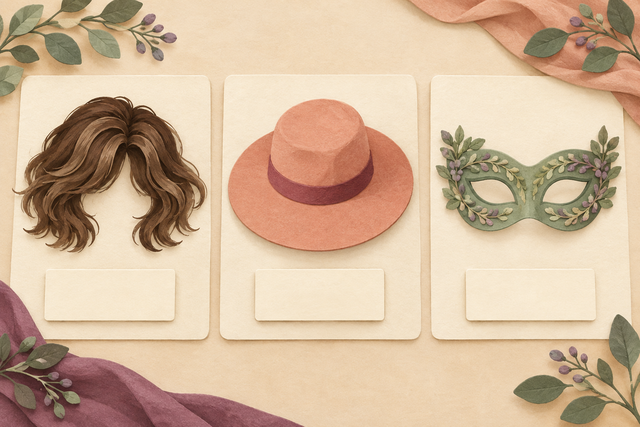
Look first at the clothes you will use. What is missing from your own idea: a different appearance for the hair, a distinctive outline above the head, or a decorative feature on the face? Write down one desired change. This gives your search a specific purpose.
You may also find that the main garment already gives the look the character you want. In that case, choosing none of the three is a complete decision. This comparison is not a list of compulsory additions.
Compare the change you want to see
The table is a starting point for your visual idea. The final effect depends on the design you are considering and your overall combination.
| Option | What I am looking at | Question for my idea |
|---|---|---|
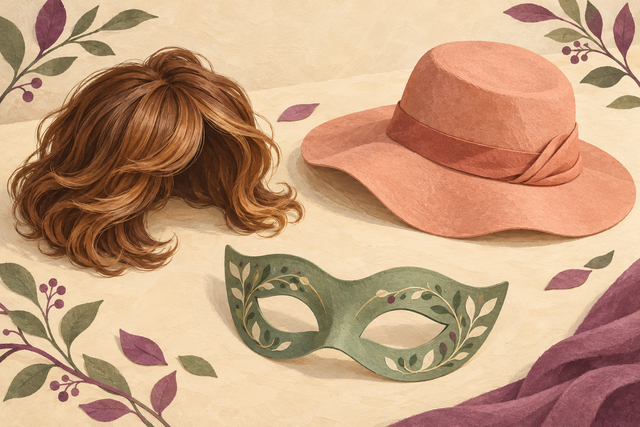
| Wig | The appearance of the hair: colour, length, shape | Is this the change I want? |
| Hat | The shape and outline around or above the head | Does it connect with the rest of the clothes? |
| Decorative mask | Its design and the area of the face it covers | Do I want this visual presence? |
Do not turn the table into an automatic ranking of comfort or suitability. A photograph alone does not tell you how the item you are considering fits or fastens.
Check the model, not just the category
For each potential accessory, look for the model’s own details: dimensions or available size, construction, intended fitting and fastening method, and what is included. If the description mentions adjustment, you need to know exactly what adjusts and any stated limits, where supplied.
Read the manufacturer’s instructions for any preparation required before use. If they are missing, record the question instead of inventing a procedure. “It is a wig” or “it is a hat” is not enough to infer fastening, fit or required extra components.
Choose what you want to wear
Separate visual interest from your own wish to wear the item. You might like a mask in a picture but not want your face covered, or have no interest in the change to the appearance of your hair that a wig offers. Treat that preference as a real criterion.
If considering a set, confirm that the accessory is separate and optional before deciding to leave it out. If it is integrated into the construction, choose another design rather than relying on detaching it. When two options serve the same purpose, compare their information and keep the one you actually want to use.
An example where the hat is enough
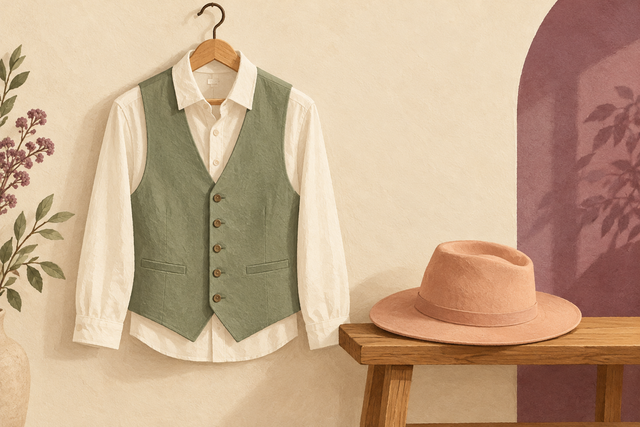
In this hypothetical example, someone has chosen an ivory shirt and green vest for the imaginary role of a celebration host. They want a clear outline above the head, without changing the appearance of their hair or covering their face.
They consider a plain peach hat, a wig and a separate decorative mask. Assume they already own the hat and know its details and how it is intended to be used. They choose it because it matches this particular visual intention and their preferences. The wig and mask are left out of the combination. The example shows a personal decision, not the superiority of hats for other roles.
Your accessory decision card
First note the change you want to see. Then complete a row for each real option you are considering, including “no accessory” if relevant.
| Option | What it adds and whether I want it | Known details or open question |
|---|---|---|
| … | … | … |
| … | … | … |
| … | … | … |
Complete the card for your own outfit and settle on an option that serves your idea, that you want to wear, and for which you have the information needed to use it.