Article contents
Start with the written contents list
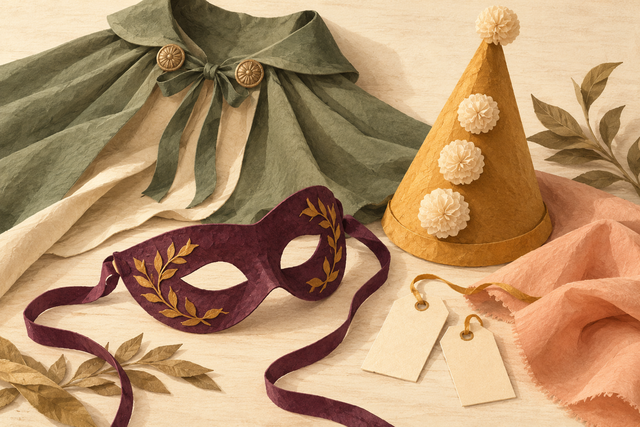
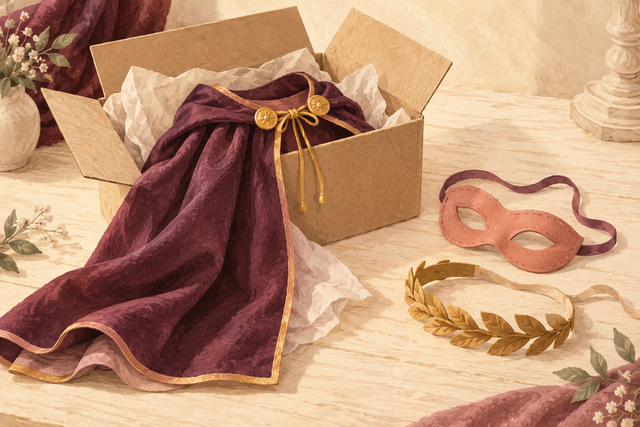
Find the written contents list for the exact costume, colour or version you have selected. Check which items are explicitly included and which are listed separately as exclusions. For each object you want from the photograph, find the corresponding information in the description before adding it to your checklist.
Do not fill a gap in the description by guessing. If the list names only a dress and a belt, mark those as confirmed. An item that appears in the picture but is not mentioned should stay under “ask first”. Its absence from the list does not, by itself, tell you whether it is sold separately.
Check what the title and piece count mean
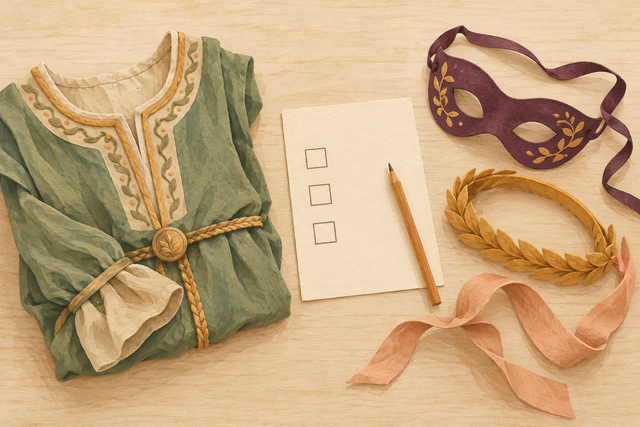
Words such as “set”, “kit”, “complete costume” and “deluxe” do not replace an itemised description. A set might contain accessories while you still need clothes to wear with them. Read what each item is and how it contributes to the outfit you want.
If a description says three pieces, look for the names of all three. Counting the visible objects in the photograph will not settle the question. A collar may be attached to a garment or supplied separately; the description needs to make that clear. Check gloves, shoe covers and headpieces in the same way. If the count and the list do not agree, ask for clarification before deciding.
Choose your own version of the outfit
You do not have to copy everything the model is wearing. Think about which details you want for your party or event and which you would leave out. An accessory can emphasise the theme without being essential to your own version.
Check the clothes and accessories you already own before adding anything to your shopping list. If an existing item could work, check its fit, colour and how you would wear it with the costume. “Not included” does not automatically mean “must buy”. Likewise, two products sharing a theme does not prove that their dimensions or fastenings work together. Keep these checks separate from whether you like the overall look.
A checklist to fill in and print
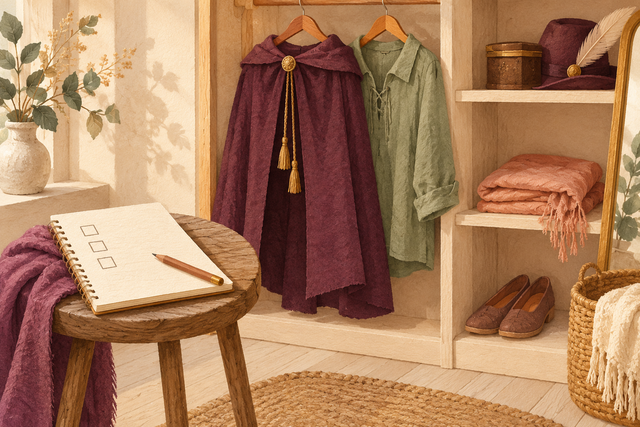
Give each part of the outfit its own row. In the middle column, write “included”, “not included” or “unknown”, using the product description. In the last column, choose “already own”, “want to add”, “leave out” or “ask first”.
| Part of the outfit | What the description says | My decision |
|---|---|---|
| Main garment | __________ | __________ |
| Headpiece | __________ | __________ |
| Belt or other accessory | __________ | __________ |
| Shoes or shoe covers | __________ | __________ |
| Another detail I want | __________ | __________ |
These rows are reminders to check, not a statement that a costume includes or needs every item. Add or remove rows to suit your choice. You can complete the table on paper without entering a name, email address or body measurements. Keep it beside the product description while you compare options.
Deal with anything that is still unclear
Note the product name, exact version and the specific item you need to check. A question such as “Does this version include a belt, and is it separate from the dress?” gives a clearer starting point than “Is it a complete costume?”.
Until you have an answer, do not count the uncertain item as part of the package or buy a second one just in case. If it is central to your choice, resolve that question first. If you would leave it out anyway, you can continue checking the rest of the outfit without treating it as an extra purchase.
Make one final check before choosing
Compare your checklist with the products you are thinking of buying. Have you added something that already comes in the package? Have you marked an item as essential even though you no longer want it? Have you checked the size and fit of each accessory separately?
When comparing two costumes, calculate each costume’s own price plus the actual prices of the extras you have chosen. This is the items subtotal, not necessarily the final order total. Check shipping and any other checkout charges separately; an unknown charge is not zero. You can then compare both options on the same basis, rather than relying on the costume price alone.
Fill in the checklist for the costume you are considering and keep only the things you genuinely need on your shopping list.