Article contents
Start with the chart for the actual costume
Find the chart that belongs to the exact design and version you are considering. Do not automatically transfer a size from another costume, your child’s everyday trousers or a general chart found online.
Check whether the numbers describe the child’s body or the finished garment. A child’s chest circumference is not the same measurement as the width of a costume laid flat. Also check whether the chart uses centimetres or inches. If the meaning or unit is missing, ask for clarification before choosing.
Take the measurements the chart actually requests
An adult should help while the child stands as shown in the measuring diagram for the specific costume. Use a flexible tape and follow the manufacturer’s instructions for positioning it. If a reading looks unexpected, repeat the measurement in the same way before writing it down.
If the chart requests height, chest, waist or hip circumference, first check how it defines each measurement. For any additional length, check the start and end points in the diagram. If the instructions are unclear, ask for clarification rather than choosing your own measuring path.
Do not add a guessed allowance to the measurements “for comfort”. Record the actual reading separately from any fit advice given by the manufacturer. That keeps the information useful when you compare more than one costume.
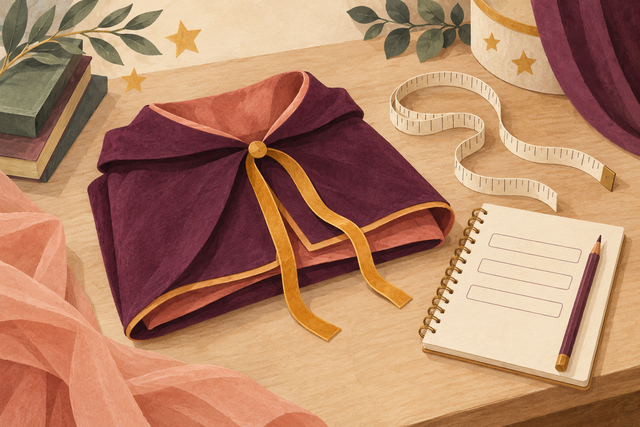
Copy or print this measurement worksheet
Fill in only the rows needed for the costume you are checking. Leave other measurements blank. Add the date so you know when the measurements were taken; the child’s name is not needed.
| Item | Your note |
|---|---|
| Measurement date | __________ |
| Costume and exact chart | __________ |
| Units used by the chart | __________ |
| Height, if requested | __________ |
| Chest circumference, if requested | __________ |
| Waist circumference, if requested | __________ |
| Hip circumference, if requested | __________ |
| Any other required measurement and its definition | __________ |
| Clothes planned underneath the costume | __________ |
| Information that needs clarification | __________ |
This sheet organises your notes. It is not a universal costume size chart and does not calculate a size. Keep it with the chart you checked so a note cannot later be mistaken for a measurement from a different design.

Check every measurement, including the awkward one
Place your notes beside the product’s chart. Compare all the dimensions it provides, rather than only the one that agrees with your preferred size. If height points to one option while waist points to another, that is a mismatch to investigate.
Look for the manufacturer’s instructions about which measurement determines the choice for this particular cut. If there are none, ask for clarification using the relevant readings and the exact costume name. Do not apply a blanket rule to buy the next size up. A larger size may change the length as well as the circumference.
When a chart gives garment measurements, you need its instructions for comparing those with the body. Simply looking for identical numbers does not establish the intended fit.
Plan the layers and the first try-on
Make a note if the costume will be worn over a top, leggings or other clothes. This is separate information to consider when choosing; it does not replace the chart’s instructions for taking body measurements. Follow any product-specific guidance about layers.
After the costume arrives, try it with the clothes and pieces intended for the event. Ask the child to walk, sit down and raise their arms. Notice where fabric pulls or where the length gets in the way. Matching a chart does not replace trying on the actual garment.
If something does not work, identify the detail: a sleeve, a fastening, the torso length or an accessory. A precise observation is more helpful than deciding that the whole costume is simply “too small” or “too big”.
Two questions before you choose
What if there is no size chart? Ask for the relevant dimensions and how they were measured. Do not fill the gap with another brand’s chart.
Should I buy a larger costume for next year? Start with the fit the child needs now. Today’s chart cannot reliably predict a suitable size after future growth.
Your next step: keep the completed worksheet and compare it with the chart for the costume you are considering.