Article contents
Define what fewer means to you
Write a short preference list before looking at complete outfits. You might want your head uncovered, prefer not to wear gloves or want no handheld props. These are personal choices; they do not need to become a general rule about what is better.
Alongside them, note what you are willing to wear: one main garment, a vest over your own clothes or a single separate accessory. A small set does not mean the same number of pieces for everyone. The aim is a clear combination you want to use, not a contest to have the fewest items.
Separate optional pieces from attached parts
For each possible outfit, read the description of its specific components. Inclusion in the package does not, by itself, tell you whether a part is separate or attached. Likewise, an element in a photograph may need separate confirmation about whether it is supplied.
Sort the parts into those you will wear, separate optional items you can leave out, and anything that needs clarification. If an unwanted hood or other part is attached, look for a different design that fits your preference. Do not plan the set on the assumption that you will detach or alter it.
Find the feature that carries the idea
Ask which piece gives your own look the role you want. It might be the silhouette of a vest, a colour combination or a motif already present on a garment. Keep that feature and consider whether the remaining pieces add something you actually want.
Look at the combination as you will finally wear it. If it does not satisfy you without the extras, you can change the role or main garment. You do not have to restore everything you ruled out simply to copy a complete picture.
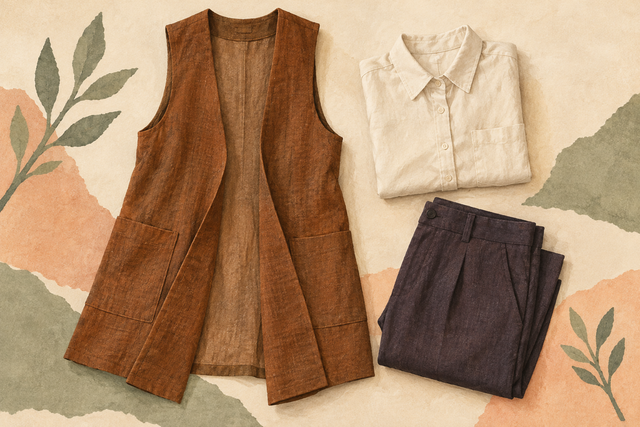
An example using three available garments
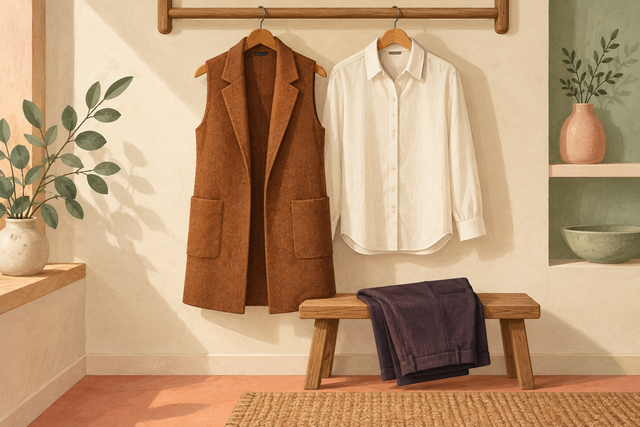
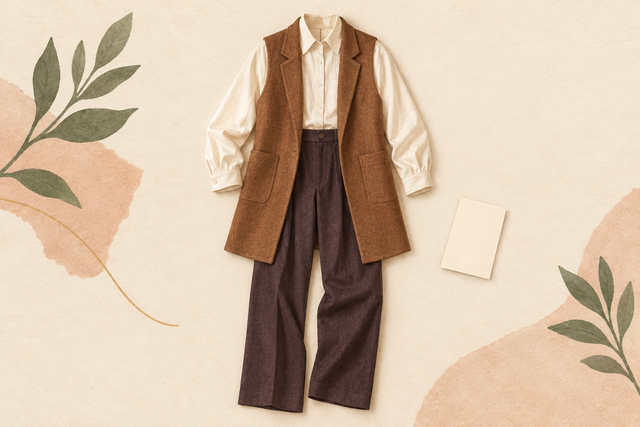
In this hypothetical example, someone wants to be a storyteller from an imaginary village, without headwear, gloves or anything held in the hands. Assume they already have a long brown vest, an ivory shirt and dark trousers, and want to wear them together.
The vest supplies the main silhouette, with the other two garments completing the combination. A hat, separate gloves and a book that appeared on the ideas list are left out. No attached part is removed: the example starts with three independent garments. The role comes from the person’s creative choice rather than a particular product.
Resolve the unknowns before choosing
Record exactly what you do not know. “Is the hood attached?” or “Is the vest a separate garment?” invite a more specific answer than “Can I wear this simply?”. Use the particular model’s details and instructions where your choice depends on its construction or use.
If essential information is missing, keep that outfit undecided. Meanwhile, you can consider another combination with clearly known components, without assuming that two similar photographs show the same construction.
Your minimum-set card
Write the role and your personal choices above the card, for example “no headwear and no handheld items”.
| Piece | Place in my set | What I know or still need |
|---|---|---|
| Main role feature | Keep: … | … |
| Supporting clothes | Keep: … | … |
| Separate optional items | Leave out: … | … |
| Attached or unclear part | Different design or clarification: … | … |
Complete the card for one look, then keep as your final set only a combination whose pieces you understand and want to wear.