Article contents
Keep one specific reference for the party
Note the decade exactly as it appears in the invitation and keep the organiser’s image or description beside it. If the invitation only says “retro”, ask for the decade or specific direction before putting the outfit together.
If the decade is clear but no image or detailed description is supplied, choose one specific visual reference for that decade as your starting point. Keep the image and note two or three features you will use. This is your own creative direction, not an additional invitation requirement. Ask for clarification when something is genuinely ambiguous or you cannot tell whether it is compulsory.
If several images have been supplied, choose one as the main reference for your look. You can use another for a detail, but note what you are taking from each. The aim is to describe your plan in one sentence rather than collect unrelated objects simply because they look “old”.
The reference for this particular party guides this choice. You do not need to claim it represents every person or every look across the entire decade.
Find two or three visible features
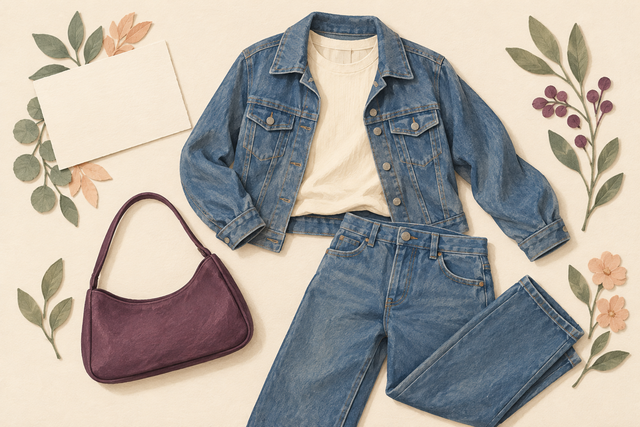
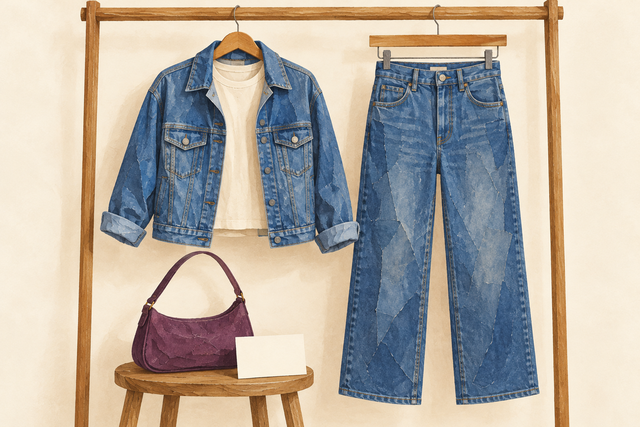
Describe what you see in plain terms: the main garments, a repeated colour, and the detail that draws your attention. “Blue denim jacket and trousers” is more useful than a vague “old-fashioned style”.
Keep two or three features to organise the outfit. Do not turn every small detail in the image into a separate requirement. If the brief leaves the accessory choice open, you can retain the colour emphasis with a different item you have available.
Separate the invitation’s explicit requirements from your own choices within the reference. A personal creative addition does not need to be presented as a historical rule.
Match the reference to pieces you own
Take out the candidate pieces and compare them with your chosen features. Beside each feature, write down one specific item you own. “Something blue” is less useful than “the blue jeans in front of me”.
Look at them together. An item may match the description on its own without being what you want beside the others. If you have two alternatives, compare them while keeping the rest of the outfit unchanged.
For anything you hope to borrow, mark availability as pending until it is confirmed. Intending to find an item does not yet make it part of a ready outfit.
Name the actual gap
A gap is a specific feature of your plan that no available piece fulfils. It is not every accessory you could possibly add.
If you already have the top, trousers and colour accent, do not put them back on a search list simply because the party has a theme. Focus on the missing piece and consider whether a confirmed loan or another version allowed by the brief could cover it.
If you decide to look for a new item, describe it precisely before browsing options. And if a detail was only your own optional idea, you can leave it out and check whether the outfit still does what you want.
A hypothetical denim brief, worked through
Hypothetical invitation: “A party themed around the 1990s. For our evening, the reference look is a blue denim jacket with blue jeans, a plain cream top and one purple accessory of your choice.”
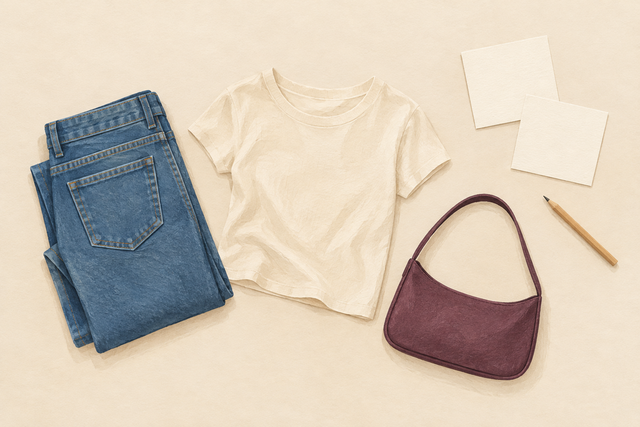
This is the creative brief for the example, not an account of how everyone dressed at the time. You have blue jeans, a cream top and a plain purple bag available. You do not have a denim jacket.
| Reference feature | What I have | Decision |
|---|---|---|
| Blue denim above and below | Blue jeans | Confirm a jacket |
| Plain cream top | Cream top | Keep it |
| One purple accessory | Plain purple bag | Fulfils the colour choice |
Next, a borrowed blue denim jacket is confirmed as available for the date. You put the four pieces together and choose this outfit. The only gap has been closed; there is no resulting need to add a hat, belt or second purple accessory simply because you are attending a themed party.
Your own decade-look card
First write: “The decade is ___ and my chosen reference for the party is ___.” Then fill in the card with items you can name.
| Feature I am keeping | Available piece I own | Gap or final decision |
|---|---|---|
| Main garments: ______ | ______ | ______ |
| Colour or combination: ______ | ______ | ______ |
| Distinctive detail: ______ | ______ | ______ |
Read the three rows as one outfit. Each chosen piece should have a clear place in your plan. Where something remains uncertain, record the exact answer you need, such as “is the borrowed jacket available on that date?”.
Fill in the card and gather the pieces that follow your chosen reference for the party.