Article contents
Read the brief and separate facts from questions
Note the theme, venue and any specific instructions in the invitation. Sort the information into “confirmed” and “needs clarification.” If the brief asks only for a colour or an accessory, do not automatically turn that into a requirement for a full costume.
For a gathering at home, ask the host about details that affect your choice. For an event venue, look for the instructions for that particular event. For a work celebration, clarify whether dressing up applies to the party or also to part of the working day. Your needs follow from that answer, rather than from a universal rule about offices.
Make questions specific. “Will we sit down for a meal?” gives you more useful information than “What should I wear?”
Turn the programme into actions
Consider the actual activities: standing and talking, eating at a table, dancing, playing a game, giving a presentation or carrying your belongings. You do not need to predict everything. Record what you know and what might change your choice.
For each activity, describe what you want to be able to do in the costume. If a game involves writing, you want your hands available. If you expect to sit for much of the event, the outfit needs to work while seated, not only while standing in front of a mirror. Try that action with the pieces you already have.
A useful question is “Which element makes this particular activity awkward for me?” The answer may concern just one object rather than the entire costume idea.
Check the space and changes between activities
Name the places you expect to use: the entrance, your seat at a table, the activity area or a place for belongings. If you do not know whether there is somewhere to leave a bulky accessory, ask before relying on being able to put it down.
If the programme moves between different areas, note the transition. A piece you want for a photograph may need somewhere else to go once a game starts. The decision is not simply “I’ll take it off,” but also “Where will it go, and who will look after it?”
Do not assume that every venue has a cloakroom or every home has storage space to spare. Without confirmation, keep open the option of a costume element you can manage yourself.
Keep the defining element and adapt the rest
Decide what makes your idea recognisable: a colour combination, a shape or an accessory. Then separate the other elements into useful and optional. This lets you adapt the costume to the activities without starting the entire choice again.
For a handheld prop, you have several possible decisions: use it for only part of the programme, replace it with something you already own, or leave it out. Choose according to your outfit and the conditions that have actually been confirmed.
If an instruction from the organizer is unclear, ask for clarification rather than assuming a smaller version of an object will necessarily meet the requirement. The aim is a workable decision based on the brief you have, not a guess about what every similar venue allows.
A hypothetical example: a party with a seated game
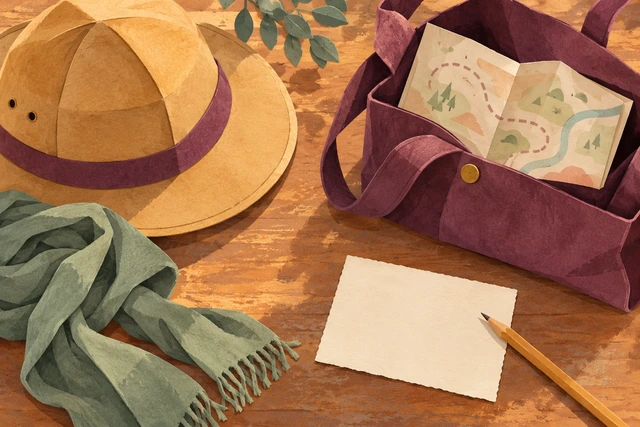
Suppose you are invited to a house party with an “explorers” theme. The host has confirmed a meal at a table, a game involving written answers and a place for bags. You already own a hat, a scarf and a decorative map. This is an example, not the policy of an actual event.
| Confirmed detail | Activity | Decision |
|---|---|---|
| Meal at a table | Sitting and eating | Try the hat and scarf while seated. |
| Game with written answers | Using my hands | Do not hold the map during the game. |
| Agreed place for bags | Leaving belongings | Put the map in my own bag there. |
The idea stays the same, but every practical choice has a specific reason. If no place for bags had been confirmed, you would need to reconsider what to do with the map. That change would affect the prop decision, without necessarily changing the theme of your outfit.
Fill in your own decision worksheet
Use one row for each condition that affects the costume. Write what you know, the relevant activity and your decision. Where information is missing, the decision can temporarily be “Ask the organizer about…”
| Venue / fact or question | Activity | Costume decision |
|---|---|---|
| … | … | … |
| … | … | … |
| … | … | … |
Read the rows together before choosing. If one element repeatedly requires handling you do not want to deal with, simplify it. The worksheet helps you choose the version of the costume that suits your particular event.
Your next step: copy the worksheet and enter one decision for each known activity in your invitation.