Article contents
1. Checking the picture but not the basket
Your final selection should match what you intended to buy: the design, version, colour, size and quantity. Read each basket line even if you remember making the selections on the product page. If you are ordering for two people, check which costume belongs to each person separately.
Where a title or small image does not distinguish two similar versions, look for the product code. The character name alone may not identify your choice clearly enough. Record the exact item so that any question you send the shop refers to the right product.
2. Choosing your usual size without checking
Your usual clothing size is a starting point, not a completed check. Compare your measurements with the chart for that particular costume, and establish whether its figures refer to the body or the garment. Do not automatically go up a size “just in case”.
Ask which chart applies if the connection to your chosen item is unclear. If your measurements do not point clearly to one option, leave this check open until you have enough information to choose.
3. Assuming everything pictured is included
Read the written contents list for your selected costume. For each accessory you see in the photograph and want to use, check whether it is stated as included. Do not use the photograph as a substitute for the description of that specific item.
Check whether anything essential to your planned outfit is missing, and whether you already own it. Also look for extras you have added separately that might already be included. If an item appears in neither the included nor excluded list, mark it as unknown instead of filling in the gap yourself.
4. Forgetting where and how you will wear it
Picture the actual occasion. Will you be sitting at a table, walking or joining activities? Check details that matter for that use, such as length, fastenings and accessories that occupy a hand. A good photograph does not answer those questions on its own.
For a school celebration or organised event, read the organiser's instructions. If you need both hands free, for example, decide whether a handheld extra is useful for your plans. Where a crucial construction detail is missing, ask about it rather than assuming the costume will work for you.
5. Comparing only the costume price
Add the base costume price to the extras you have actually decided to buy, using the correct quantities. That gives you the item subtotal. The final order amount also needs any charges shown for your address and chosen delivery or payment method, together with any discount that has actually been applied.
If shipping or another charge has not appeared yet, it is still unknown; it is not zero. Compare the final total with your budget before confirming the order, rather than relying on the first price you saw.
6. Confusing dispatch with arrival
Write down the date you need the costume and read exactly what the delivery information says. A dispatch date concerns the parcel leaving the seller, not reaching you. Check whether the timing shown applies to your address and selected service.
An estimated arrival does not become a guarantee because it suits your plans. If it is close to your event or the wording is unclear, ask for clarification and consider a fallback you already own. As part of the same check, reread the recipient's name, address and postcode.

7. Leaving the terms until something goes wrong
Before paying, read the shop's current terms for the purchase you are considering. Find the stated process for a size exchange or return, the deadlines, related charges and any specific wording about your chosen item. Do not carry over assumptions from another shop.
If information is missing, ask a precise question using the product code. Keep the reply with your purchase details. Note what you would need to do yourself and what the shop still needs to clarify.
Your checklist before placing the order
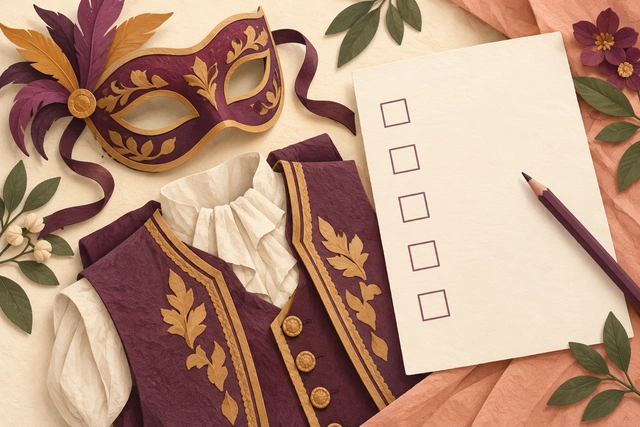
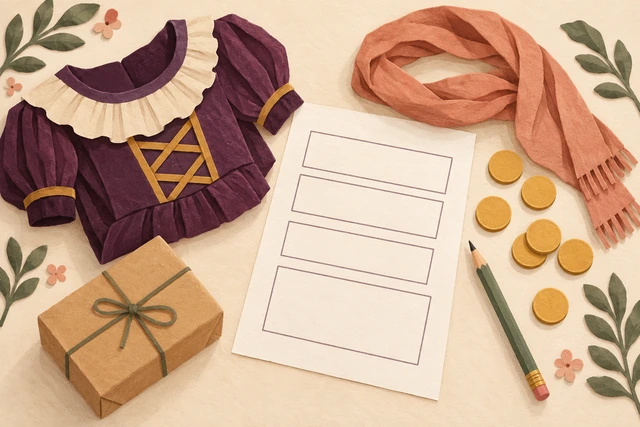
Copy or print the table. Give each row one of three decisions: Confirmed, Ask, or Change my choice. Add the evidence behind it: a product code, measurement, amount or clear answer.
| Check | What I need to establish | Decision / note |
|---|---|---|
| 1. Selection | Correct item, version and quantity | __________ |
| 2. Size | Measurements and the applicable chart | __________ |
| 3. Contents | What arrives and what I am adding | __________ |
| 4. Use | Suitable for my occasion and practical needs | __________ |
| 5. Cost | Final order total, not just the item subtotal | __________ |
| 6. Delivery | Arrival timing and correct recipient details | __________ |
| 7. Terms | Stated process, deadlines and charges | __________ |
“Ask” stays open until you receive a useful answer. “Change my choice” means updating the basket and repeating any checks the change affects. There is no need to turn uncertainty into a rushed yes.
Fill in all seven rows now and resolve every open point before placing your order.